 Chef Matt Cooks
Carryover Cooking Explained: Why Food Keeps Heating
- What is carryover cooking?
- Why does food keep heating after it leaves the pan?
- Which foods show the most carryover?
- Carryover is not permission to miss a safety minimum
- Measure the actual centre, not the convenient spot
- Build a carryover record for a repeat cook
- How do you monitor the rise after removal?
- What makes carryover larger or smaller?
- Diagnose an unexpected result
- Handle hot food and equipment safely
- Sources
What is carryover cooking?
Carryover cooking is the rise or continued change inside food after it leaves direct heat. The surface is hotter than the centre, so stored heat keeps moving inward while heat also escapes to the room. The amount is not fixed: food size, shape, cooking method, surface heat, resting vessel, and covering all change the result. Use a thermometer to observe your own repeat cooks, and never assume carryover will supply a required safe minimum temperature.
This is why a roast can climb after it leaves the oven while a thin cut may level off quickly. It is also why “pull it five degrees early” is not a universal rule. That number can be reasonable for one recorded steak method and wrong for a larger roast, a thin fillet, a gentler oven, or a different resting setup.
Why does food keep heating after it leaves the pan?
Cooking creates a temperature gradient: the outside receives energy from the pan, oven, grill, or hot liquid before the centre does. When the food is removed, the heat source disappears, but the hotter outer layers and cooler centre have not yet reached the same temperature. Heat continues moving from hotter regions toward cooler ones.
At the same time, the surface loses heat to the air, plate, board, or rack. The centre rises only while inward heat transfer exceeds the heat leaving that area. Eventually the reading peaks, then begins to fall.
Thermapen's current carryover explanation uses the same heat-transfer model and identifies shape, size, and cooking method as variables. USDA guidance also notes that cooking continues longer in dense foods such as a whole turkey or beef roast than in less-dense foods such as breads, small vegetables, and fruit.
The practical lesson is simple: the burner can be off while the temperature is still changing. “Off the heat” describes the location, not an instant end to energy movement.
Which foods show the most carryover?
Larger, thicker foods often show more carryover than small, thin pieces because they hold more heat and their centre is farther from the surface. A high-heat method can also create a steeper difference between a hot exterior and a cooler interior than a gentler method.
Those are tendencies, not a prediction table. A compact roast, a long narrow roast, and several individual chops can have different heat paths even at similar total weight. Bone, stuffing, fat distribution, starting temperature, and contact with a hot pan add more variables.
The resting setup matters too:
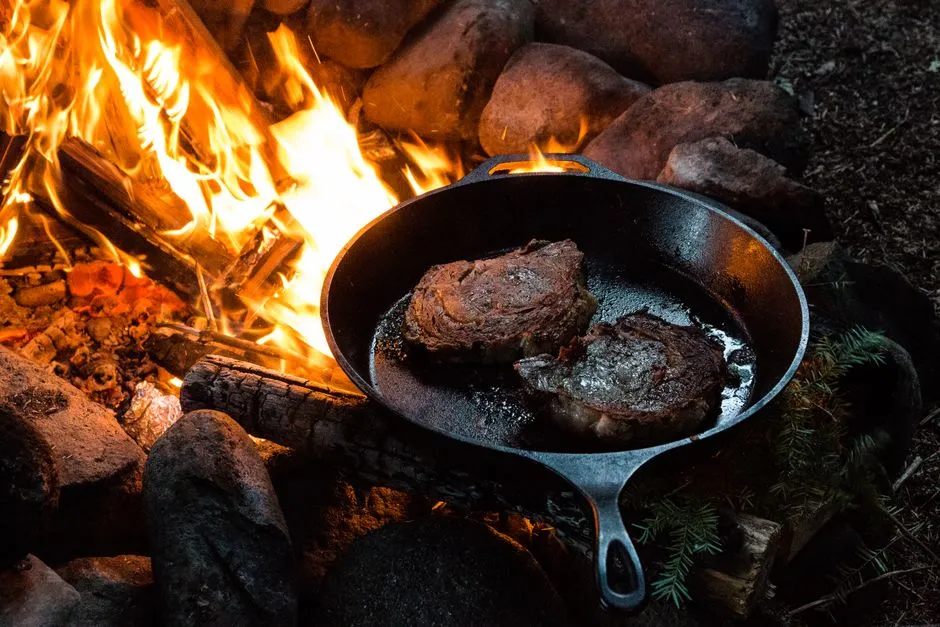
- Food left in a hot cast-iron pan continues receiving heat from the pan.
- Food moved to a room-temperature rack loses surface heat differently.
- Foil or a lid reduces some heat loss and can soften a crisp surface with trapped moisture.
- Slicing creates new surfaces and changes the heat path, so a whole item and cut portions do not carry over the same way.
Do not turn those observations into a reason to ignore the recipe. They explain why repeat measurement is more useful than borrowing somebody else's offset.
Carryover is not permission to miss a safety minimum
Set food safety first. USDA's consumer chart says whole beef, pork, veal, and lamb steaks, chops, and roasts must reach 145°F (63°C) before removal from the heat and then rest for at least three minutes. Ground beef, pork, veal and lamb must reach 160°F (71°C), while all poultry — including ground poultry — and casseroles must reach 165°F (74°C). Fish and shellfish have a 145°F (63°C) minimum on that chart.
Those are minimums, not suggested final quality targets, and they are not interchangeable. A three-minute rest is attached to the whole-cut rule; it does not turn a lower removal temperature into that rule. Do not subtract an expected carryover rise from a government minimum unless a current authoritative method for that exact food explicitly provides a validated time-temperature process.
If a package, tested preservation method, or public-health authority gives a different product-specific instruction, follow it. This article cannot see the food, its thickness, its preparation, or the people being served.
Our steak-searing guide contains its own steak-specific cooking and resting method. Keep its figures attached to that method rather than applying them to poultry, ground meat, fish, or a roast.
Measure the actual centre, not the convenient spot
Use a clean food thermometer suited to the food's thickness. USDA instructs cooks to measure the thickest portion or centre of fish, and its broader chart requires internal temperatures measured with a food thermometer. The FDA Food Code identifies the geometric centre or thickest part as the key measurement point and calls for a probe suitable for the product thickness.
For a thick item, search for the coolest central reading rather than accepting the first warm number. Insert from the side when that gives a better path to the centre of a thin chop, fillet, or patty. Avoid touching bone, the pan, or a pocket of fat, because that is not the edible centre you are trying to assess.
Do not leave an instant-read thermometer in the oven or food unless its manufacturer says it is designed for that use. USDA warns that some thermometer faces can melt near heat and that only heat-safe models should remain in food during cooking. Its page also suggests moving pan-cooked food to a clean spatula or plate before inserting the thermometer sideways when that helps prevent burned fingers.
Wash the probe with hot, soapy water or according to its instructions between uses. Store a sharp probe in its sheath.
Build a carryover record for a repeat cook
The safest useful prediction comes from the same food and method cooked more than once. Create a short record rather than relying on memory.
Write down:
- the food and cut;
- its weight and thickest dimension;
- whether it was bone-in, stuffed, or cooked in portions;
- the cooking appliance, pan, and heat setting;
- the lowest correct internal reading at removal;
- where it rested and whether it was covered;
- the highest centre reading during the rest; and
- the final texture and serving result.
For the first run, do not deliberately remove a high-risk food below its required safe minimum. Meet the applicable rule, then continue observing the rise. On a later repeat, use the record to prevent overshooting a quality target only within the safe, authoritative method for that food.
Keep the probe in the same anatomical or geometric area on each repeat. A reading from the thin end on one cook and the centre on the next does not describe carryover; it describes two different places.
How do you monitor the rise after removal?
Place the food on the intended resting surface and take a centre reading immediately after removal. Continue checking at consistent intervals until the reading stops rising and begins to fall. A leave-in probe simplifies the record when it is rated for both the cooking and resting conditions.
With an instant-read thermometer, minimise repeated punctures and clean the probe between foods. Keep the food stable, keep fingers away from the sharp probe, and do not balance a hot roasting pan at the counter edge while measuring.
Record the peak rather than deciding in advance what it “should” be. If the rise is smaller than expected, do not serve food that has missed its safety minimum. Return it to heat and cook to the required endpoint, checking again with the thermometer.
What makes carryover larger or smaller?
Food size and shape
A thick, compact item has a different centre-to-surface path from a thin, broad one. Compare like with like. Weight alone does not capture shape.
Cooking intensity
Higher surface heat can create a steeper gradient between exterior and centre. A gentler cook may leave less stored surface heat to travel inward after removal. The visible browning of the outside does not tell you the centre temperature.
The hot vessel
A food left in a heavy pan or roasting dish is not fully away from its heat source. Move it to the recipe's stated resting surface if the goal is to stop pan contact. Use dry oven gloves and set the hot vessel on a heat-safe surface.
Covering and surroundings
A cover changes heat and moisture loss. A warm room, cold plate, rack, or enclosed container also changes the path. Keep the rest setup consistent when comparing results.
Cutting and portioning
Cutting releases heat faster and can interrupt the observation. Do not carve before a required safety rest has finished. Once the specified rest is complete, follow the recipe's serving method.
Diagnose an unexpected result
The centre rose much more than last time
Check whether the item was larger, thicker, cooked with higher heat, left in a hotter vessel, or covered more closely. Also verify that both readings came from the same central area and that the thermometer is functioning as its maker describes.
The centre barely rose
The food may be thin, the cooking method gentle, or the resting surface quick to draw away heat. It may also have been measured in a different spot. Never respond by serving below a required minimum.
One side is overdone and the other underdone
That is uneven cooking, not simply a carryover problem. Pan position, food shape, appliance hot spots, or inconsistent thickness may have created multiple temperature zones. Check more than one place and use the lowest relevant reading for safety.
The crisp surface turns soft
Trapped steam from a tight cover or flat plate may be softening it. Use the recipe's resting setup. Do not remove a required cover or rest merely for texture when the authoritative method attaches it to safety.
Handle hot food and equipment safely
Move roasting dishes, pans, racks, and probes deliberately. Use dry oven gloves, keep handles away from the counter edge, and set hot equipment on a stable heat-safe surface. Open foil or lids away from your face because trapped steam can burn.
Do not carry a hot pan around while searching for a thermometer. Prepare the clean probe and resting place before the food reaches its endpoint. Keep raw-food utensils and plates separate from cooked food.
Carryover cooking is measurable, but it is not a promise. Meet the applicable safety rule, record the real rise from a repeatable method, and let the thermometer—not a borrowed offset—show what happens next.
Sources
- USDA Food Safety and Inspection Service: Food Thermometers
- USDA Food Safety and Inspection Service: Leftovers and Food Safety
- FDA: 2022 Food Code, thermometer measurement guidance
- Thermapen: Why Meat Keeps Cooking as It Rests
Frequently asked questions
Why does food keep cooking after the heat is off?
The food's exterior is hotter than its centre. After removal, stored heat continues moving inward while heat also escapes from the surface. The centre can rise until those transfers reverse and cooling takes over.
How many degrees does carryover cooking add?
There is no universal number. Size, shape, cooking intensity, pan, resting surface, and covering all affect the rise. Record removal and peak temperatures for the same repeated method instead of borrowing an offset.
Can carryover cooking finish meat to a safe temperature?
Do not assume it will. USDA requires its stated minimum temperature before removal for common meat and poultry categories, with a three-minute rest specifically attached to whole beef, pork, veal, and lamb cuts.
Where should I place a thermometer to measure carryover?
Use a probe suited to the food's thickness and find the thickest or geometric centre, avoiding bone, the pan, and pockets of fat. Keep the measurement location consistent between repeat cooks.
Does covering food increase carryover cooking?
Covering changes heat and moisture loss and may change the centre's rise, but the effect depends on the food and setup. Record whether food was covered when comparing repeat cooks.