 Chef Matt Cooks
Basic Knife Cuts: 9 Classic Chef Cuts Explained, With Sizes
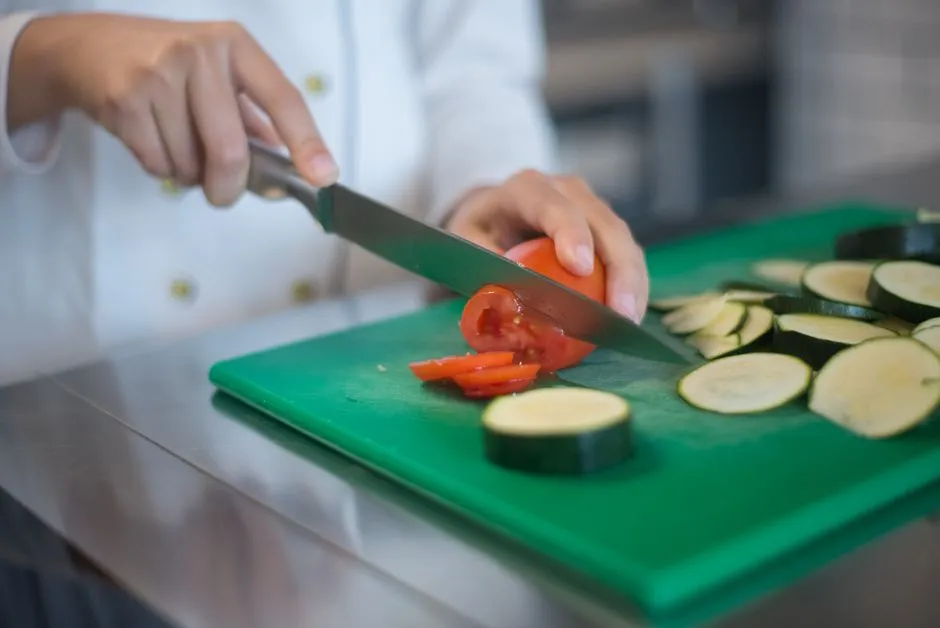
- What Are the Basic Knife Cuts?
- Knife Cuts Chart: All 9 Cuts With Measurements
- The Dice Family: Large, Medium, Small, and Brunoise
- The Stick Cuts: Batonnet and Julienne
- The Flat and Ribbon Cuts: Paysanne and Chiffonade
- Mince: The Everyday Fine Cut
- How to Dice an Onion, Step by Step
- Why Uniform Cuts Actually Matter
- Grip, Board, and Blade: The Setup That Makes Cuts Possible
What Are the Basic Knife Cuts?
The basic knife cuts are a set of standard shapes — dice, brunoise, julienne, batonnet, paysanne, chiffonade, and mince — most of them with defined dimensions, that professional kitchens use so every piece of food cooks at the same rate and looks intentional on the plate. The measured cuts are specific: a medium dice is a 1/2-inch cube, a julienne is a 1/8-inch matchstick, a brunoise is a tiny 1/8-inch cube. The two loose ones, chiffonade and mince, are defined by fineness rather than an exact figure. Learn the sizes, and any recipe instruction from "small dice" to "chiffonade of basil" becomes precise instead of vague.
That's the whole point of the system. When a recipe says "dice the carrots," it isn't just asking you to make them smaller — it's asking you to make them the same size as each other, so nothing is raw in the middle while its neighbor turns to mush. This guide covers the nine cuts worth knowing, with the measurements culinary schools actually teach, plus a walkthrough of the single most useful application: dicing an onion.
Knife Cuts Chart: All 9 Cuts With Measurements
Here are the classic cuts at a glance. Dimensions follow standard culinary-school specs; the metric figures are rounded to workable numbers, because nobody is measuring millimeters mid-prep.
| Cut | Dimensions (inches) | Dimensions (metric) | Shape | Typical use |
|---|---|---|---|---|
| Large dice | 3/4 × 3/4 × 3/4 | ~2 cm cube | Cube | Stews, roasted vegetables |
| Medium dice | 1/2 × 1/2 × 1/2 | ~13 mm cube | Cube | Soups, braises |
| Small dice | 1/4 × 1/4 × 1/4 | ~6 mm cube | Cube | Salsas, mirepoix for quick soups |
| Brunoise | 1/8 × 1/8 × 1/8 | ~3 mm cube | Tiny cube | Garnishes, refined sauces |
| Batonnet | 1/4 × 1/4 × 2–2.5 | 6 mm × 6 mm × 5–6 cm | Thick stick | Crudités, fries |
| Julienne | 1/8 × 1/8 × 2 | 3 mm × 3 mm × 5 cm | Matchstick | Stir-fries, slaws, garnish |
| Paysanne | 1/2 × 1/2 × 1/8 | 13 mm × 13 mm × 3 mm | Thin square/tile | Rustic soups |
| Chiffonade | ~1/16 wide ribbons | 1–3 mm wide | Ribbon | Basil, mint, leafy greens |
| Mince | Under 1/8, irregular | Under ~3 mm, irregular | Fine bits | Garlic, shallot, ginger, herbs |
Two patterns make the chart easier to hold in your head. First, the three smallest dice halve at each step — 1/2 inch, 1/4 inch, 1/8 inch — with large dice sitting above them at 3/4 inch, which is the one size in the family that isn't a doubling of its neighbor. Second, the two stick cuts are the parents of the two smallest cubes: slice a batonnet crosswise and you get small dice; slice a julienne crosswise and you get brunoise. Large and medium dice have no stick cut of their own on this chart.
The Dice Family: Large, Medium, Small, and Brunoise
All four dice cuts are made the same way; only the ruler changes.
The method: square off the vegetable first. Trim a thin slice from one side so it sits flat and stable, then trim the remaining sides into a rough block. Cut the block into slabs of your target thickness, stack the slabs and cut them into sticks, then cut the sticks crosswise into cubes. Slab, stick, cube — every dice in the book is those three moves.
- Large dice (3/4-inch / ~2 cm cube). For food that cooks a long time — beef stew, roasted root vegetables. Big pieces survive an hour of simmering without dissolving.
- Medium dice (1/2-inch / ~13 mm cube). The workhorse for soups and braises. If a recipe says "dice" with no size, this is a safe reading.
- Small dice (1/4-inch / ~6 mm cube). Small enough to fit several pieces on a spoon, which is why it's the standard for salsas, relishes, and vegetable soups where you want a bit of everything in every bite.
- Brunoise (1/8-inch / ~3 mm cube). The precision cut. At this size, shallot or carrot nearly melts into a sauce, contributing flavor without visible chunks — which is exactly what you want when finishing a pan sauce with minced shallot or a fine vegetable garnish.
The honest note: nobody expects laser-cut cubes at home. What matters is that your pieces are consistent with each other. A pot of mostly-1/2-inch dice cooks evenly; a pot of pieces ranging from 1/4 inch to 1 inch never will.
The Stick Cuts: Batonnet and Julienne
Stick cuts stop one step before dicing — slab, stick, done.
Batonnet is a 1/4 × 1/4-inch stick, about 2 to 2.5 inches long (6 mm square, 5–6 cm long). Picture a slightly slimmed-down french fry — that's the shape, and fries are its most famous application. It's also the standard for vegetable crudités and any sauté where you want sticks that keep some bite.
Julienne is the batonnet's finer sibling: 1/8 × 1/8 inch, about 2 inches long (3 mm square, 5 cm long) — a true matchstick. Julienned vegetables cook in a minute or two, which makes the cut ideal for stir-fries, quick pickles, slaws, and raw garnishes. Carrot, daikon, bell pepper, and snow peas all take beautifully to it.
Julienne vs Brunoise: What's the Difference?
Julienne and brunoise share the same 1/8-inch cross-section but differ in the final shape: julienne is a 2-inch matchstick, while brunoise is a 1/8-inch cube made by cutting julienne crosswise. In other words, brunoise is diced julienne. If you can cut a clean julienne, you're one row of crosswise cuts away from a clean brunoise — which is why culinary schools teach them together, and why sloppy julienne always produces sloppy brunoise.
The Flat and Ribbon Cuts: Paysanne and Chiffonade
Paysanne (French for "peasant-style") is a thin square tile — roughly 1/2 × 1/2 × 1/8 inch (13 × 13 × 3 mm). It's the practical cut: lots of surface area for fast, even cooking with less knife work than a dice. Traditional French vegetable soups use it constantly, and it's a smart everyday cut for carrots, zucchini, and potatoes when you want speed without ragged chunks.
Chiffonade is the ribbon cut for leafy herbs and greens — basil, mint, sage, spinach, sorrel. Stack the leaves, roll the stack into a tight cigar, and slice thinly across the roll. The result is a pile of fine ribbons, typically 1–3 mm wide (roughly 1/16 inch), that distribute evenly over a dish instead of sitting in torn clumps. One technique tip: use one decisive slicing stroke per cut. Sawing back and forth bruises tender leaves, and bruised basil blackens fast.
Mince: The Everyday Fine Cut
Mince is the least formal cut on the list — no single official dimension, just "as fine and even as you can get it," generally under 1/8 inch (~3 mm). It's how you handle garlic, shallot, ginger, and hardy herbs when you want their flavor everywhere and their texture nowhere.
The efficient method: slice thinly first, then gather the slices and rock the knife through the pile, keeping the tip anchored to the board with your free hand flat on the spine. Rotate the pile a quarter turn every few passes. Thin initial slices matter more than furious rocking — you can't mince your way out of thick slices.
How to Dice an Onion, Step by Step
The onion deserves its own walkthrough because its layers do half the work for you — and because it's the cut you'll use most. Here's the standard method:
- Halve it pole to pole. Cut from the root end through the stem end, then peel each half.
- Trim the stem end only. Leave the root end intact — it's the clamp that holds the layers together while you cut.
- Lay a half flat and make horizontal cuts parallel to the board, stopping about 1/2 inch short of the root. Two cuts for a medium dice; more, closer together, for finer.
- Make vertical cuts from stem toward root, again stopping short of the root end. Space them at your target dice size.
- Slice crosswise and cubes fall away with each stroke. Discard the root nub at the end.
Match the spacing of your cuts in steps 3 and 4 to the crosswise slices in step 5 and you get even cubes automatically. Practice pays off immediately: evenly diced onions are the difference between silky, uniformly browned caramelized onions and a pan where thin shreds burn while thick chunks stay crunchy.
Why Uniform Cuts Actually Matter
It's tempting to treat knife cuts as chef vanity. They're not — they're heat management with a blade. Three concrete reasons to care:
- Even cooking. A 1/4-inch cube of carrot cooks dramatically faster than a 3/4-inch cube. Mix sizes in one pan and you must choose between undercooked large pieces or blown-out small ones. Uniform cuts remove the choice.
- Predictable timing. Recipe times assume the stated cut. "Simmer 20 minutes until tender" is written for a specific size; cut bigger and the recipe's clock is wrong. This is half of what heat control really means — the other half happens at the stove.
- Better texture and flavor release. Fine cuts like brunoise and mince expose more surface area, so aromatics give up flavor faster and disappear into the finished dish. Big cuts hold texture. Choosing a cut is choosing how an ingredient behaves.
Grip, Board, and Blade: The Setup That Makes Cuts Possible
No cut on this page works well with a bad setup. Three fixes cover most home-kitchen problems:
- Pinch grip. Hold the blade itself between thumb and the side of your bent index finger, just ahead of the handle, with the remaining fingers wrapped around the handle. It feels odd for a day and then gives you control a handle grip never will.
- Claw hand. Curl the fingertips of your guiding hand under, knuckles forward, so the flat of the blade rides against your knuckles. Your fingertips stay tucked behind the cutting edge.
- Stable board, sharp knife. Put a damp paper towel under a sliding board. And hone your knife regularly — a dull blade needs more pressure, and pressure is what causes both slips and crushed, uneven cuts.
Start with medium dice and the onion method, add julienne when that feels natural, and save brunoise for when you want to show off. Nine cuts sounds like a curriculum; in practice it's one motion — slab, stick, cube — applied with different rulers.
Frequently asked questions
What are the most common basic knife cuts?
The nine cuts most worth knowing are large dice (3/4-inch cube), medium dice (1/2 inch), small dice (1/4 inch), brunoise (1/8-inch cube), batonnet (1/4-inch stick), julienne (1/8-inch matchstick), paysanne (thin 1/2-inch square), chiffonade (ribbons roughly 1/16 inch wide), and mince (irregular, under about 1/8 inch). The three smallest dice halve at each step — 1/2 inch, 1/4 inch, 1/8 inch — which makes most of the chart easy to remember; large dice sits above them at 3/4 inch.
What is the difference between julienne and brunoise?
The cross-section is identical — both measure 1/8 inch square — but the length is not. Julienne stays a stick roughly 2 inches long, while brunoise is what you get by turning those sticks and cutting them down into 1/8-inch cubes. That dependency is why the two are taught in sequence: a brunoise can only be as even as the julienne it was cut from.
What is chiffonade and how do you do it?
It is the ribbon cut used for leafy herbs and greens such as basil, mint, and spinach. Pile several leaves on top of one another, roll the pile lengthwise into a tight cylinder, then cut across the cylinder to release ribbons about 1 to 3 millimeters (roughly 1/16 inch) wide. Let the blade travel in one clean pass — a back-and-forth sawing motion crushes the leaf cells, and crushed basil darkens within minutes.
What size is a standard dice in cooking?
If a recipe says "dice" without specifying a size, medium dice is the safe reading: a cube of about 1/2 inch (13 mm) on each side. Large dice is 3/4 inch, small dice is 1/4 inch, and brunoise — the finest dice — is 1/8 inch. Match the size to cooking time: bigger cubes for long stews and braises, smaller ones for quick soups, salsas, and sauces.
What is the easiest way to dice an onion?
Halve the onion from root to stem, peel it, and trim only the stem end so the root holds the layers together. Lay each half flat, make horizontal cuts toward the root (stopping short of it), then vertical cuts spaced at your target size, then slice crosswise so even cubes fall away. The intact root end acts as a clamp, which is what makes the method fast and safe.
Do knife cuts really need to be exact sizes?
Not at home — consistency matters far more than precision. Pieces cook evenly when they match each other, so a pot of mostly-1/2-inch dice behaves well even if no cube is perfect, while a mix of 1/4-inch and 1-inch pieces never cooks evenly. The stated dimensions are targets that keep your cuts consistent and let recipe timings work as written.